The Maryland Community Ambassadors for Prevention (MCAP) program was created by MCASA and our partners at DAWN to prevent sexual violence within Maryland’s Deaf and Hard of Hearing community. Through community education,resource sharing, and community outreach, MCAP strives to promote positive social norms change and build connected and resilient communities. Ambassadors are trained under the MCAP Training Institute to deliver educational and trauma-informed sexual violence prevention content to local groups. Ambassadors are also available to attend and engage with community members and groups through community outreach, including local events and social media campaigns while sharing prevention information and connecting community members to various types of resources.
About the MCAP Training Institute
The MCAP Training Institute is a 4-6 week long training program that utilizes a train-the-trainer model to recruit, hire, and train Ambassadors to deliver sexual violence prevention programming for Deaf and Hard of Hearing audiences. The Training Institute is led by MCASA and DAWN staff and consists of both live virtual learning sessions, in-person practice sessions, and self-paced learning. Ambassadors gain knowledge to be leaders in the field of sexual violence prevention.
Community Trainings
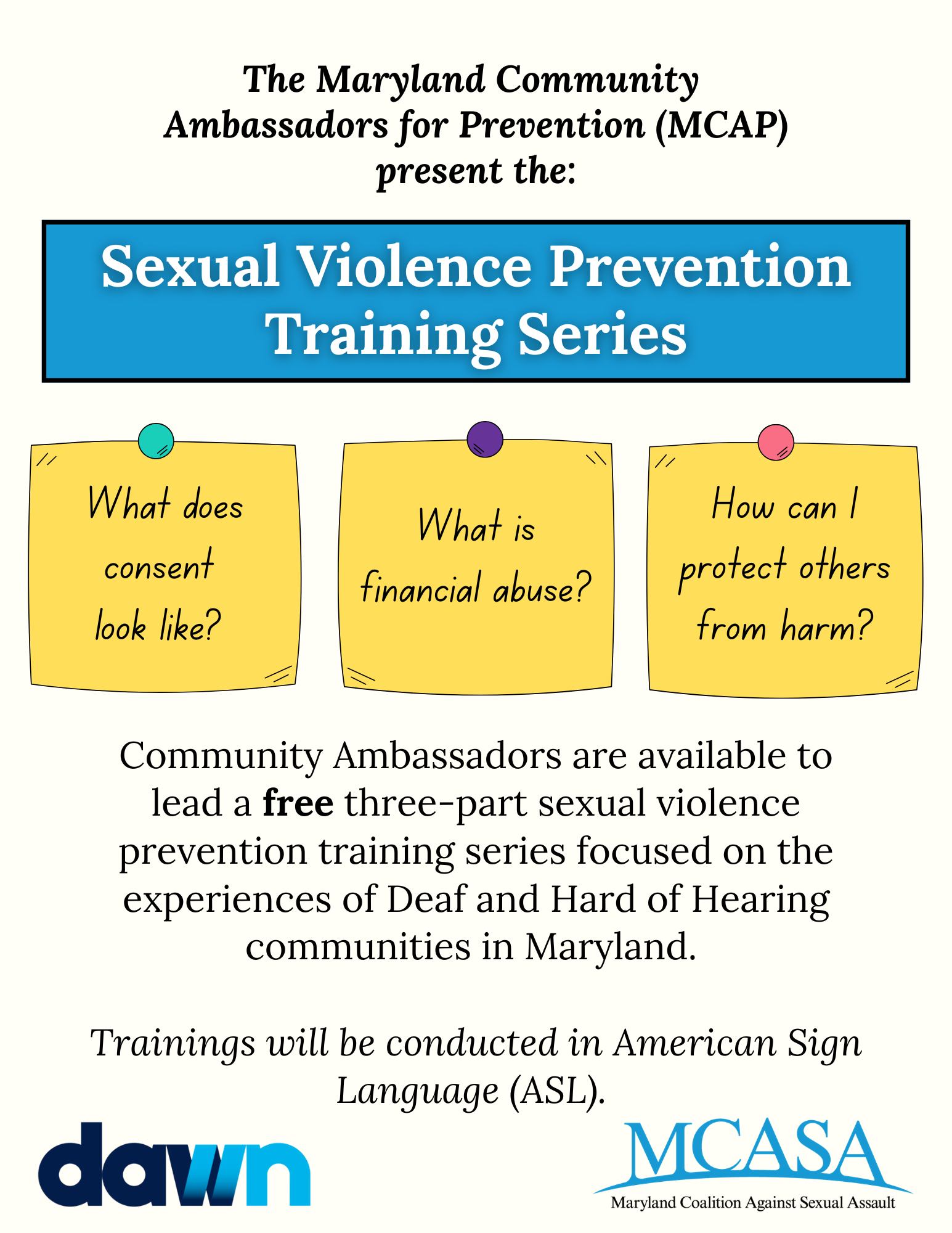
Our training content is designed for community groups and organizations across Maryland’s Deaf and Hard of Hearing community. MCAP Ambassadors are available to lead a free, three-part community training both in-person or virtually. The following topics are covered in this training series:
Part 1: Introduction to Sexual Violence Prevention (90 minutes)
Part 2: Financial Empowerment as Sexual Violence Prevention (90 minutes)
Part 3: Bystander Intervention for Sexual Violence Prevention (90 minutes)
It is strongly recommended that training participants attend all three parts in this training series to get the most out of this educational experience.
These trainings will be conducted in American Sign Language (ASL). All are welcome.
If your group or organization is interested in receiving this training, please fill out the training request form. For more information, contact [email protected].
This project is supported by the Centers for Disease Control and Prevention of the U.S. Department of Health and Human Services (HHS) as part of a financial assistance award with 100 percent funded by CDC/HHS. The contents are those of the author(s) and do not necessarily represent the official views of, nor an endorsement, by CDC/HHS, or the U.S. Government.